Met Gala 2026
“Inner landscapes: emotions in form”. Six looks for the Costume Art theme of the Met Gala 2026: each gown gives shape to an emotion through the work of a master of abstract art. Two of the looks, Disagio and Rabbia, were made.
- Theme
- Costume Art
- Season
- SS 2026
- Looks
- 6 designed · 2 made
- Boards
- 28
The body as an artistic device
“Fashion is not an accessory, but the system of signs that shapes our identity.” The concept starts from the vision of Costume Art: the garment is not a separate object but the language that gives form to the body. At the heart of the collection is one question, “How do we tell the story of our body today?”, between Renaissance classicism and post-human distortion.
Moodboard, colours and fabrics
Six abstract artworks make up the moodboard, gathered in a gilded frame. The colour chart runs from Obsidian Black to Ice White, through Burnt Earth, Intense Cobalt Blue, Plum and Golden Mustard; the fabrics are silk organza, chiffon and charmeuse, silk-and-polyester taffeta and stretch satin.
Six emotions, six masters
Each look translates an emotion through an artwork: Paura, fear (Kandinsky, Composition VII); Tristezza, sadness (Rothko, No. 14, 1960); Disagio, unease (Malevich, Black Square); Rabbia, anger (Pollock, Number 1A, 1948); Gioia, joy (Kandinsky, Composition); and Sorpresa, surprise (Mondrian, Broadway).
Illustrations and technical drawings
Each illustration sits beside the painting that inspired it and the front and back technical drawing, with the construction notes: internal stays to hold the shape, invisible zips, interwoven ribbons, appliqué circles, gathering and metal eyelets.
The two garments made
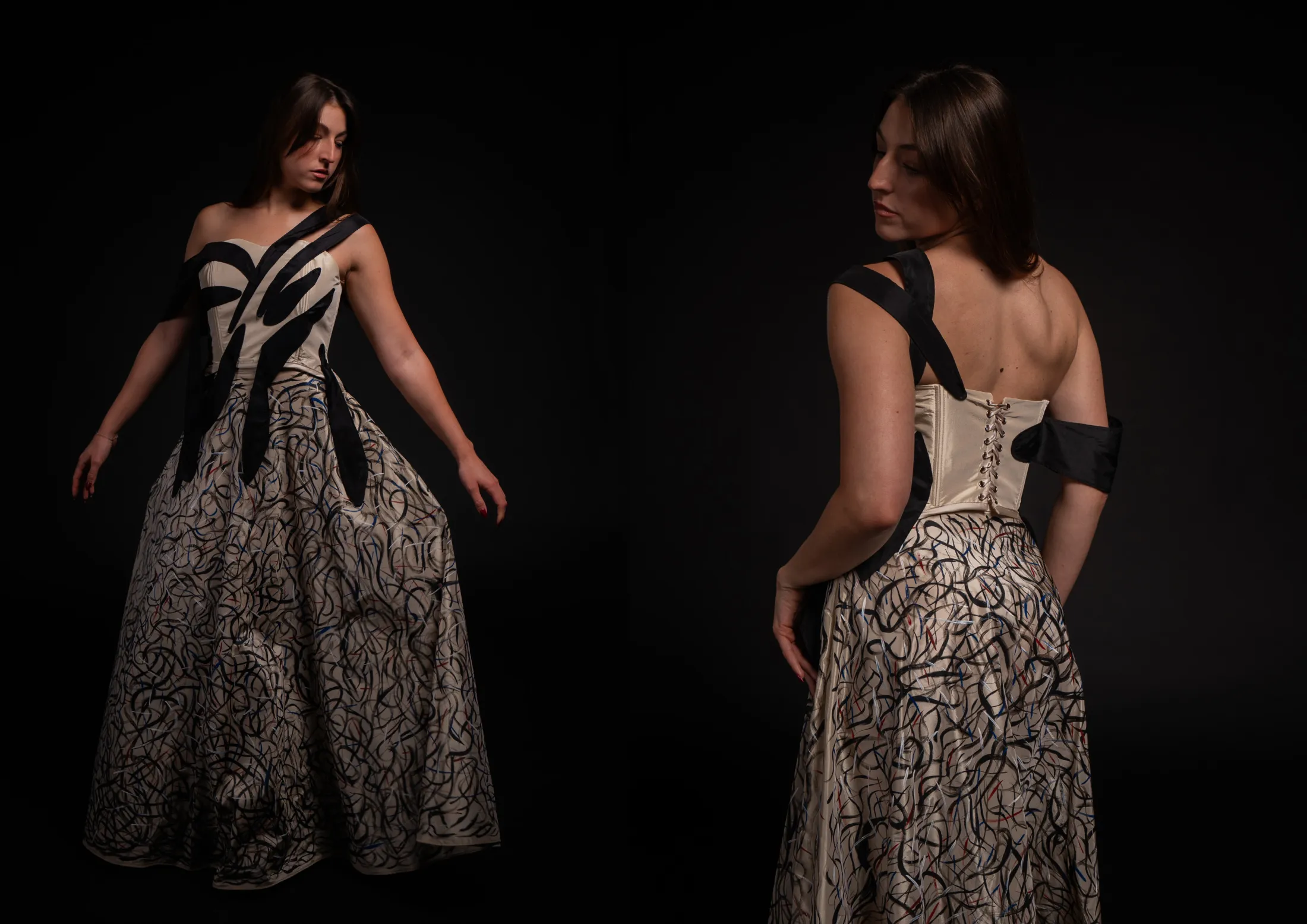
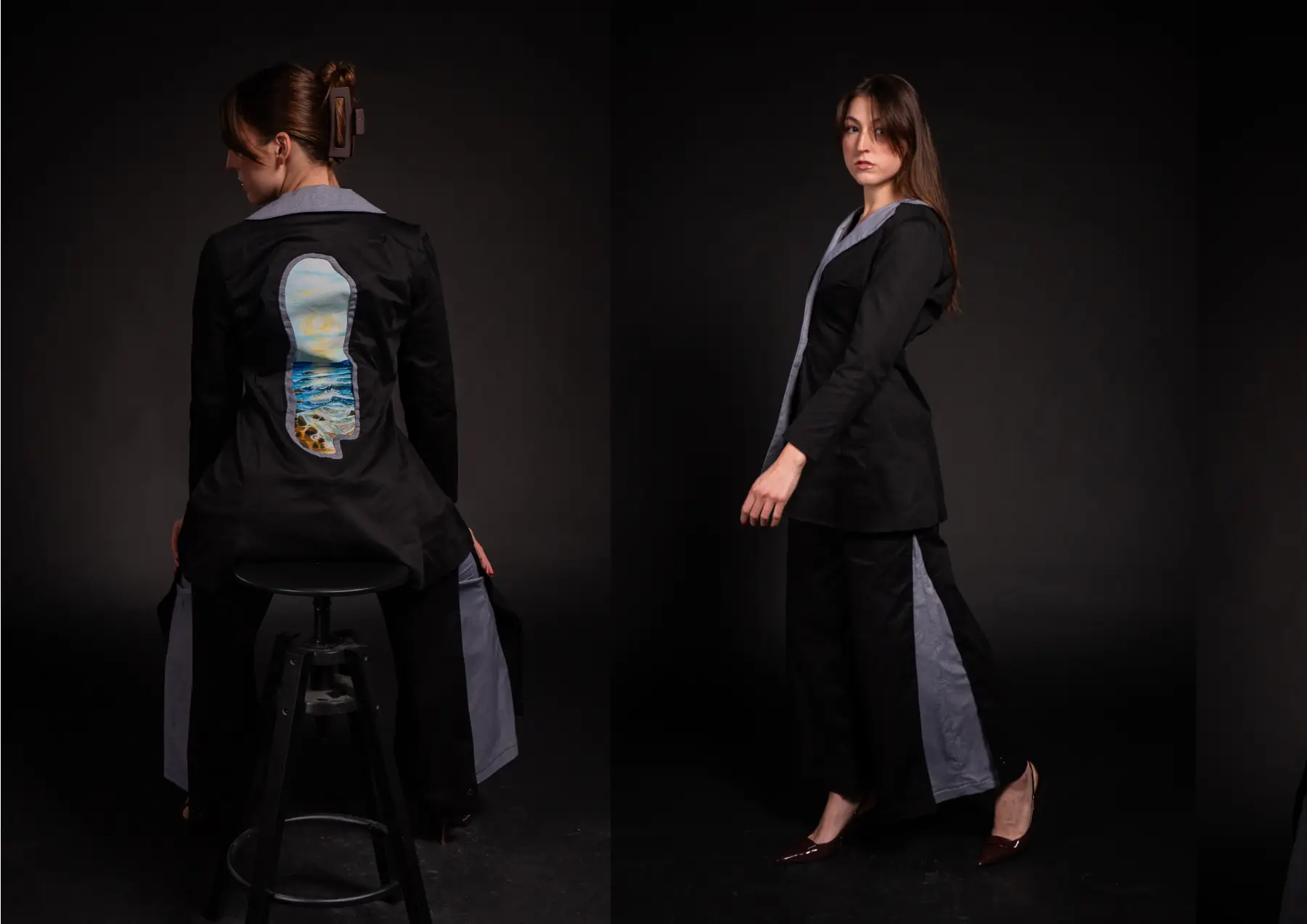
Disagio (hooded top and skirt) and Rabbia (corset and long flared skirt) went from drawing to garment. The sheets set out silhouette, fit, measurements and materials: taffeta in 64% polyester and 36% silk, a pure silk organza hood, 4 mm metal eyelets and 5 mm boning.
From cutting to finishing
The work in the studio, step by step: channels marked at 0.5 cm for the corset boning, eyelets set with a punch, French seams, irregular pressing for the crinkled effect of Disagio’s taffeta and, for Rabbia, a skirt painted freehand to recreate the texture of Pollock’s painting.
The garments, worn
Disagio and Rabbia photographed in the studio against a black background.
Let’s work together.
For collaborations, projects and appointments. Florence — open to travel.
selenatoska12@gmail.com